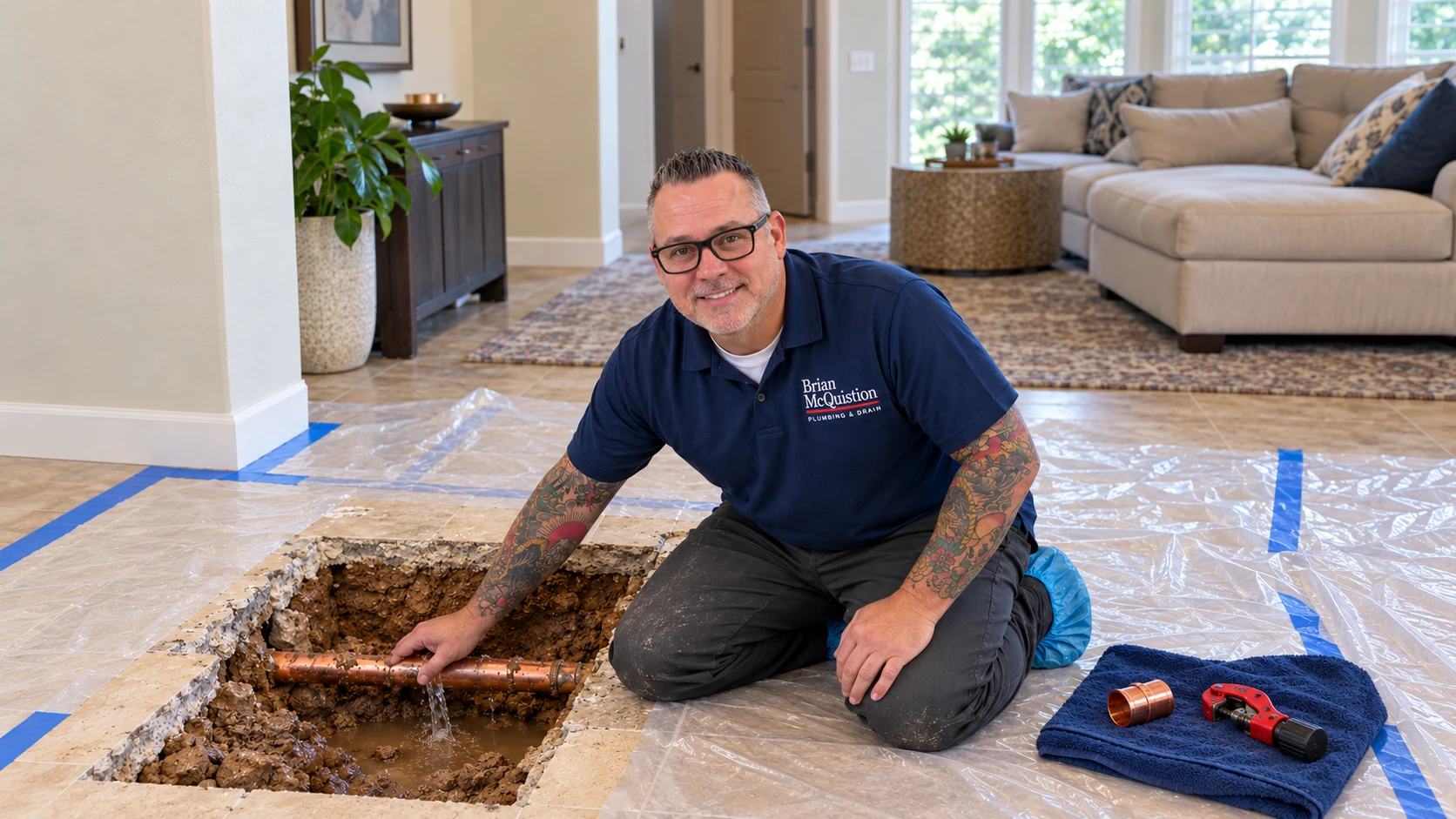
Repiping makes sense when leaks keep showing up in different parts of the house. One leak is a repair. A pattern of leaks is the signal to talk about something bigger. Here is what to look at first.
What should I look at first?
Start with your history. Pull out old invoices from repair calls, or write down what you remember: where each leak was, when it happened, and what was done. Then look for these signs.
- Leaks in more than one place, especially in different rooms.
- A new leak soon after a repair, in a different spot.
- Stains, damp spots or peeling paint that come back after being fixed.
- A water bill that climbs with no change in how you use water, which is also one of the slab leak warning signs.
- Water that looks discolored or flow that seems weaker than it used to be.
None of these proves the pipes are worn out. A stain can come from a roof, and weak flow can come from a clogged aerator. But when several show up together, or the same ones keep coming back, a plumber should look at the whole system rather than the latest problem.
It also helps to ask whoever did your last repair what they noticed. A plumber who had the pipe open has seen more of it than you have.
Does my house's age tell me what pipes I have?
Not reliably. Valley homes were built across many decades, and pipes get repaired, replaced and added over time. Don't assume what's behind your walls from the year your house was built.
The better question is what your pipes are made of and what shape they're in. A licensed plumber can tell you what they can see, what they can't, and how confident they are.
Does hard water matter?
It helps to know your own water hardness. It describes the minerals in your water. It doesn't pass judgment on your pipes.
The number depends on who supplies your water. For example, EPCOR's 2025 Water Quality Report for Sun City says: "The hardness in your water ranges from 7 to 11 grains per gallon (gpg)." Other providers publish other figures, and some publish none, so look up your own provider's report. Our Sun City page covers that area.
Should I repipe or keep repairing?
There's no formula, and be wary of anyone who offers you one over the phone. These are the questions that decide it:
- How many leaks have there been, and are they in different places?
- What did the plumber see in the pipe around the last repair?
- How long do you plan to stay in the house?
- What would another leak cost you in damage and disruption?
- Can you take on a larger project now, and when would suit you?
One leak in a house that has otherwise been quiet often doesn't call for a repipe. Repeated leaks in different places are a different conversation. You know your house's history better than anyone.
Is it ever smart to wait?
Sometimes. If your leaks were all in one place and traced to one cause, if the house is otherwise quiet, or if you plan to sell soon, a repair may make more sense. Waiting can be a sound choice, as long as you keep watching for the signs above and keep a record. What you don't want is to keep paying for repairs without ever asking the bigger question.
Copper or PEX?
If you decide to repipe, you'll be asked to choose a material. Ask your plumber what they recommend for your house and why, and get the answer in plain words. Our copper vs PEX comparison walks through how the two stack up, so you can go into that conversation with questions ready.
Who can do the work, and do I need a permit?
Whoever does the work should be licensed in Arizona. Ask any contractor for their Arizona ROC license number, and check it with the Arizona Registrar of Contractors before you sign anything. Ask for a written scope, and ask who pulls the permit.
Permit rules are set by each city, so ask your plumber and confirm with your city's building or permit office. Don't rely on a general answer for the whole Valley.
What should a repipe estimate include?
Every house prices out differently, so there are no numbers here. What changes the price:
- How many fixtures and lines are involved.
- How easy the pipes are to reach.
- What has to be repaired or repainted afterward.
- The material you choose.
- Permits and inspections.
Ask what's included and what isn't. Ask how long the work will take and what will need to be opened, and get those answers before you agree to anything, because they depend on your house. We give you the price before we start, and you approve it first.
What should I do while I decide?
Keep a simple record of every leak: date, room, hot or cold line, what was repaired. Take photos. Know where your main shutoff valve is, so you can act fast if a new leak shows up. If you're planning other work, such as a remodel, tell the plumber, since it can change the decision.
When should I call a licensed plumber?
Call when leaks are repeating, when the signs above are stacking up, or when a plumber has told you the pipes look worn. Expect a plumber to ask about your leak history, look at the pipes they can reach, and explain what they see and what they can't. Ask for your options, not a single answer. If someone pushes a repipe on the first visit without explaining why, ask for the reasoning.
Weighing a repipe and want a second set of eyes on your leak history? Talk with us about repiping.
Common Questions
There is no magic number. Look at whether leaks are repeating, whether they are in different places, and what the plumber saw in the pipe. A licensed plumber can look at your history and help you decide.
Ask your plumber what they recommend for your house and why. Our copper vs PEX comparison lays out how the two compare.
Permit rules are set by each city. Ask your plumber, and confirm with your own city's building or permit office.
That depends on your house. Before you agree to anything, ask your plumber to explain the plan, what will need to be opened, and how long the work will take.