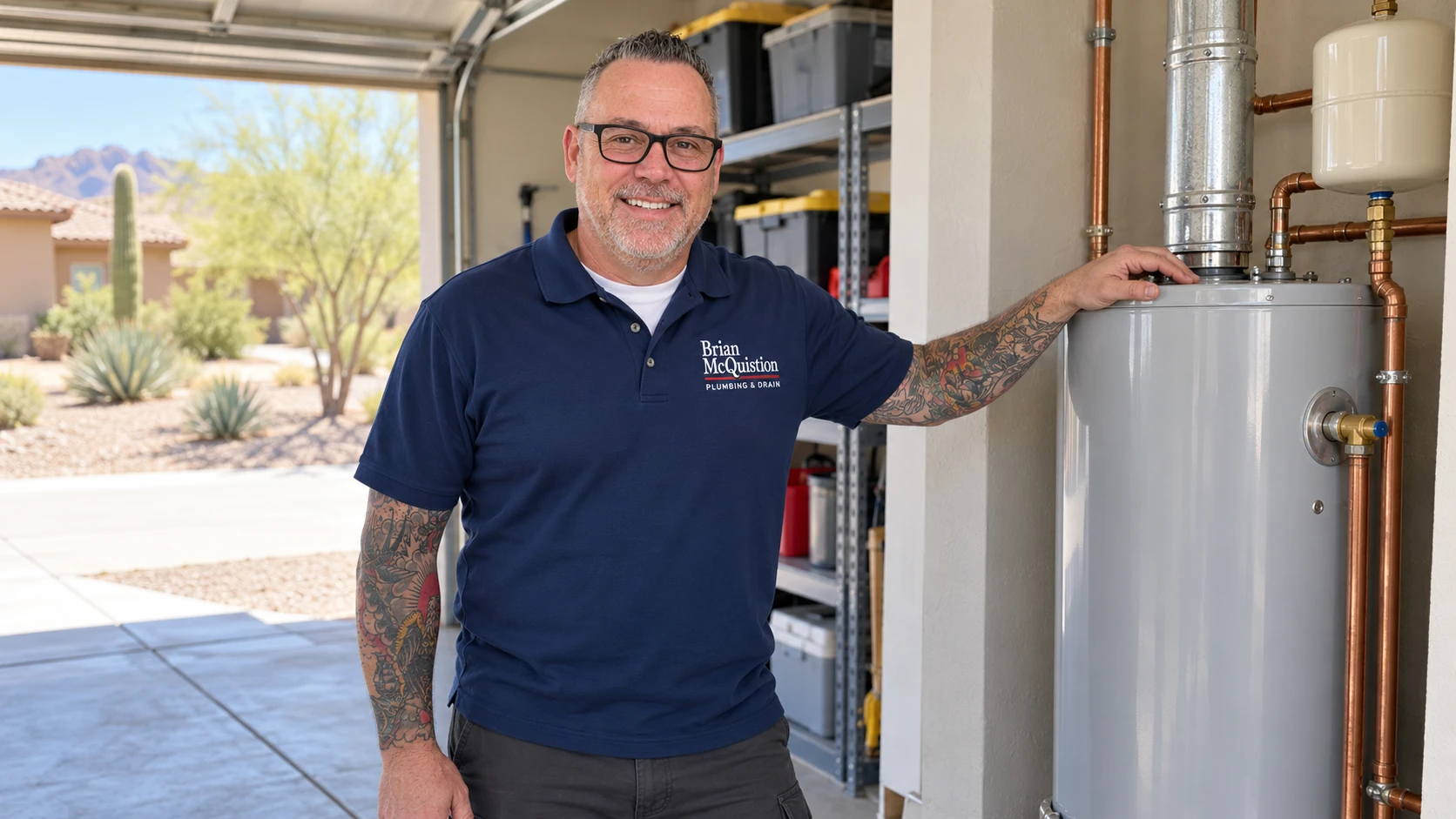
Which one fits your house?
Neither type wins everywhere. A tank heater fits when you have the space, a standard hookup, and a simple replacement in mind. A tankless heater fits when the house can support it and you care about floor space, energy use, and not waiting on a tank to recover.
A tank heater stores hot water and keeps it warm, so it's ready when you open the tap. When the stored water runs low, you wait for the tank to catch up. A tankless heater has no storage. Water runs through a heat exchanger and heats only while a hot tap is open.
So the question isn't which one is better. It's which one your gas supply, venting, power, and daily habits can support. The tankless vs traditional comparison puts the two side by side. This post is about matching one to your house.
Does tankless save money?
It can save energy. The U.S. Department of Energy's Energy Saver guidance says tankless heaters generally use less energy than storage tanks, because they don't keep a tank of water hot around the clock. It also says the gap is bigger in homes that use less hot water and smaller in homes that use a lot.
Energy saved isn't the same as money saved. A tankless install usually costs more up front, and the savings show up slowly on the utility bill. Whether they ever catch up depends on how much hot water your household uses, what you pay for gas or power, and how long you stay in the house.
If you plan to stay put, use hot water at a steady pace, and want the smaller footprint, tankless deserves a serious look. If you may sell in a few years, or the old heater just quit and hot water is the priority, a tank is often the easier fit. Tankless savings reward people who stay.
Both types can run short. A big family can empty a tank with several showers back to back. A tankless heater has its own ceiling, because each model can only heat so much water at once. Sizing matters either way.
Can your house handle a tankless heater?
This is where a lot of tankless plans change. A tankless heater isn't a tank moved onto the wall. It has different needs, and a licensed plumber should check them before you commit. The check covers:
- Gas supply. A gas tankless unit needs a lot of gas at once. Some installs need a larger gas line and some don't, so the model's specs and your existing line decide it.
- Venting. It needs a proper exhaust route, and that route isn't always the same as your old heater's.
- Power. Many gas tankless units need an electrical connection for their controls and fan, so an outlet has to be close by.
- Space. A wall-mounted unit frees up floor, but it still needs clearances and a spot that works for the vent and the pipes.
- Local rules. Permit and code details depend on your city, and a licensed plumber knows what yours requires.
Electric tankless models put their own demands on the home's electrical service, so the same check applies.
Converting from a tank to tankless is often possible, but it's rarely a plain swap. Gas line, venting, and power work are jobs for a licensed professional. Nobody should guess at them, and nobody should be talked into a tankless heater before the house has been looked at.
Does Phoenix hard water change the choice?
It matters for both types. The City of Phoenix Water Services 2025 Water Quality Report lists total hardness of 172 to 302 ppm in its distribution system. Other Valley providers report different numbers, so look up your own.
In a tank, minerals settle as sediment on the floor. In a tankless unit, they build up as scale on the heat exchanger and can cut flow and efficiency. Manufacturers call for periodic descaling, and hard water makes that upkeep matter more. Ask what the manual for the model requires, and plan for it before you buy, not after.
A softener can reduce scale for either type. The water heater lifespan post goes deeper on what hard water does inside a tank.
What changes the price of the job?
We won't put a number in a blog post. It would be a guess, because the number depends on your house. What actually moves it:
- Tank or tankless, and the size or capacity of the unit
- Gas line size, and whether it has to change
- The venting route and materials
- Electrical work or a new outlet
- Where the heater goes, and how far that is from the old one
- Safety parts and connections your city's code calls for
- Add-ons, such as a recirculation pump on a tankless unit
You approve the price before any work starts. Ask for the quote with these items spelled out, and compare tank and tankless on the same terms. A lower price that leaves out the gas line isn't lower.
When should you call a licensed plumber?
Call before you buy a unit, not after. A licensed plumber can look at your gas line, venting, power, and the spot where the heater lives, then tell you whether tankless works in your house or a tank is the smarter fit. Sizing the heater to your household is part of that visit.
If the answer is tankless, the gas line sizing, venting, and electrical work belong to a licensed professional. If the answer is a tank, the same visit covers the connections and safety parts.
Brian's been a Valley plumber for 20+ years, and the goal is a heater that suits your house, not the biggest box on the truck. Still weighing the two? Ask about tankless water heater options and find out what your house can actually support.
Common Questions
It can save energy. The U.S. Department of Energy's Energy Saver guidance says the savings are larger in homes that use less hot water. Whether that outweighs the higher install cost depends on your usage and how long you stay.
Often, but it is rarely a simple swap. Tankless units can need different gas line sizing, venting, and power, so a licensed plumber has to check your house first.
Yes. Minerals build up as scale on the heat exchanger, and manufacturers call for periodic descaling. Ask what the manual for your model requires.
A tank can run out once the stored hot water is used. A tankless heater keeps heating, but every model has a flow limit, so several hot taps at once can strain it.