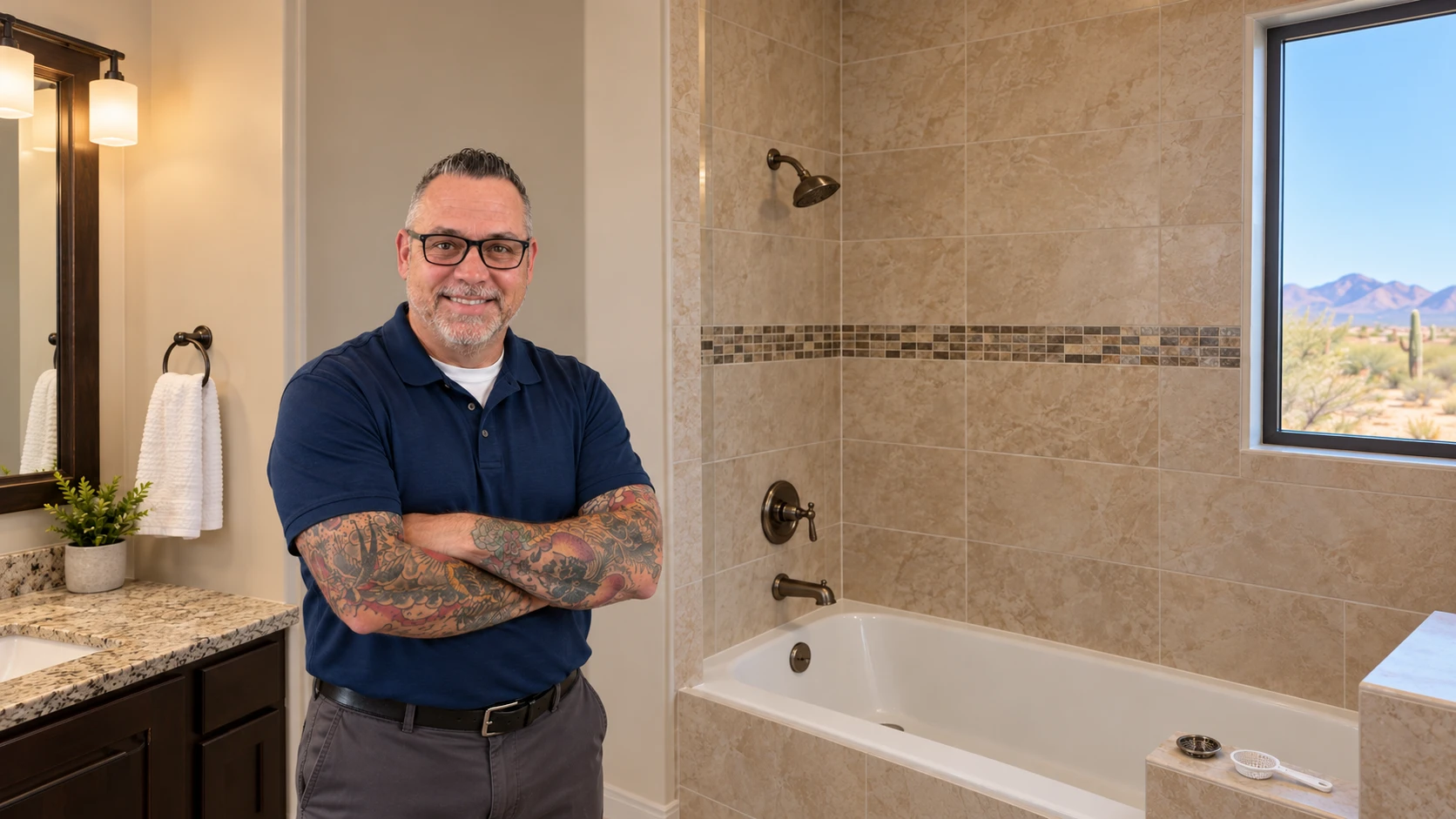
Before a kitchen or bath remodel starts, settle the plumbing. Decide where fixtures are going, who's handling the permit, and what you'll do if old or surprising pipe turns up. Those decisions are easier to make while the walls are still closed and the schedule still has some give.
Do I need a plumber before the contractor starts?
It's smart to have one. A licensed plumber can walk the space with you, look at what's there, and tell you what your new layout means for the pipes. That conversation works best before you finalize a design, not after.
If your home is on a slab foundation, ask the plumber what they can learn about where the drains run before you commit to a layout. That one fact shapes what you can move and how much work it is.
What changes if I move a toilet, sink or shower?
Moving a fixture usually means moving both its water supply and its drain, and the two aren't equally easy. Supply lines bring water in under pressure. Drains carry it out and rely on gravity, so a drain needs a path that lets water flow downhill.
That's why a small move on paper can be a big job in the wall or the floor. In a slab home, ask your plumber how they'd handle a drain move, what it would disturb, and whether a different fixture location would avoid it. Don't assume the answer. It depends on the house.
If a shower or tub is moving too, our shower and tub page covers that kind of work.
Do I need a permit?
Permit rules are set by each city, and they can depend on the scope of the work. Before demo, ask your plumber and your contractor whether your project needs a permit, and who is responsible for pulling it. Then check with your city's building or permit office.
Ask when any inspection has to happen, because it can affect when walls are allowed to close. Skipping a required permit or inspection can cause problems later, so get the answer in writing.
Should I replace shutoffs and supply lines now?
Look under the sink and at the toilet. Are the shutoff valves easy to reach and easy to turn? Do the supply lines look worn, corroded or kinked? Once walls and cabinets are open, these parts are easier to reach than they'll ever be again.
Point out anything that's stiff, leaking or hard to reach, and ask your plumber whether replacing it now makes sense. It's a short conversation before demo, and a much longer one after the new cabinets are in.
What if we find old pipe behind the walls?
It can happen once walls open. Don't guess at what you're looking at. Stop, take photos, and ask your plumber to look before anyone works around it. Old pipe doesn't automatically mean a big job, but it does mean a decision.
Talk through your choices ahead of time so you're not deciding under pressure:
- Replace the section in the remodel area only.
- Replace more of the plumbing while the walls are open.
- Leave it alone if it's outside the work area and your plumber sees no reason to touch it.
Each choice has trade-offs in cost, time and risk, and only someone who has seen the pipe can weigh them. If the discussion turns to replacing lines throughout the house, our repiping page covers that service.
What should I decide about fixtures before demo?
Finalize your fixture choices before demolition if you can. Faucets, sinks, toilets and showers each come with different hookup needs, and the plumber has to plan around the real thing, not a guess.
Bring the plumber this information:
- The faucet type and how many holes the sink or countertop has.
- The toilet model or its rough-in measurement, which is the distance from the wall to the drain.
- The sink style: undermount, drop-in or vessel.
- Special features: a pot filler, an instant hot tap, a filter, a second sink.
- The shower or tub valve and trim, if you've already chosen them.
You don't need to have bought everything, but spec sheets and dimensions let the plumber plan supply and drain work around them.
What is the order of operations?
Every project is different, so treat this as a sequence to ask about, not a rule:
- Walk the space with a licensed plumber and list what's there.
- Finalize the layout and the fixtures.
- Confirm the permit and who pulls it.
- Schedule demo so the plumber and the contractor are coordinated.
- Have any required inspection done before walls close.
- Finish the connections, then handle any final inspection before you rely on the new plumbing.
What changes the price?
Every remodel is different, so we won't guess at a number. These things move the price: whether fixtures stay put or move, how hard the pipes are to reach, what has to be repaired afterward, what you find behind the walls, and permits and inspections. Leave room for a surprise, and decide in advance who you'll call if one turns up.
We give you the price before we start, and you approve it first. Ask for the scope in writing so you know what's included.
When should I call a licensed plumber?
Call before demo is on the calendar, and before you order fixtures you can't return. Expect a plumber to look at the room, ask about your plans, and tell you what they see. Bring your layout ideas and your fixture specs, and ask the questions in this post. If you're not sure whether something is a plumbing decision, ask anyway.
Brian McQuistion brings 20+ years as a licensed Phoenix Valley plumber to the planning. To sort out your kitchen or bath plumbing before the walls come down, start with our kitchen and bath page.
Common Questions
It is smart to have one look at the space before the design is final. That is when you can talk through fixture moves, drains and permits without disrupting the schedule.
Moving a fixture usually means moving both its supply and its drain, and drains are the harder part. In a slab home, ask your plumber how they would handle it and what it would disturb.
Permit rules are set by each city and can depend on the scope of the work. Ask your plumber and contractor, and confirm with your city's building or permit office.
If they are stiff, leaking, worn or hard to reach, ask your plumber whether replacing them now makes sense. They are easier to get at while walls and cabinets are open.
Stop, take photos, and have your plumber look before anyone works around it. Old pipe does not automatically mean a big job, but it does mean a decision about how much to replace.